
Guide to Industrial Fire Risk Management
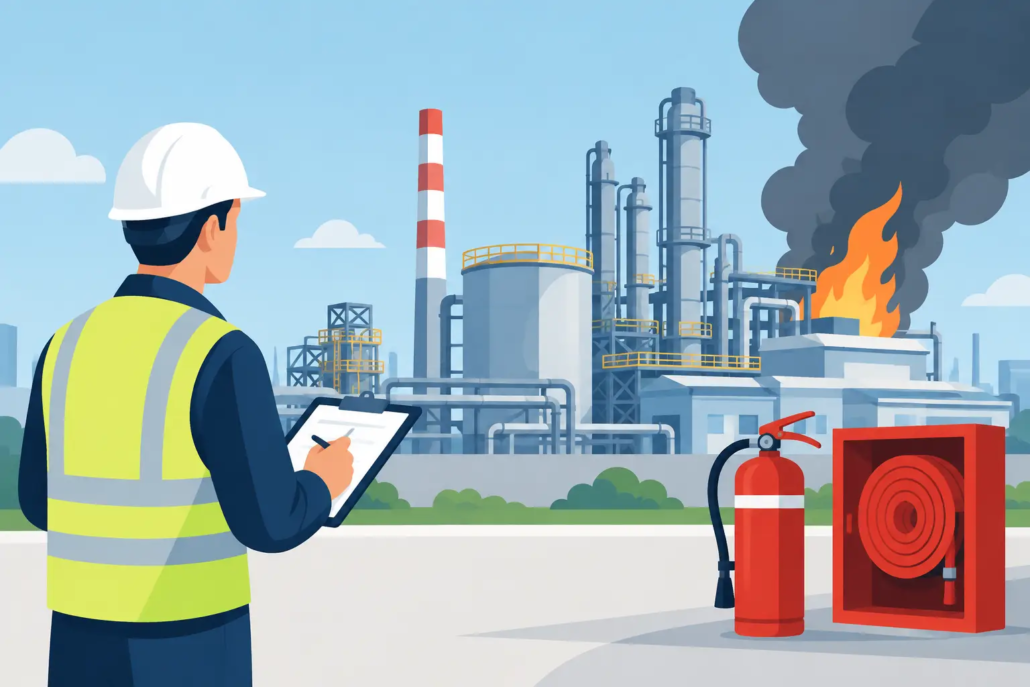
A fire at an industrial facility is rarely confined to the department where it originates. It can halt production lines, compromise critical assets, disrupt supplies, give rise to liability toward third parties, and render a site inoperable for weeks or months. An effective industrial fire risk management guide must therefore go beyond mere regulatory compliance: it must translate risk into verifiable design, operational, and organizational decisions.
For a risk manager, a plant manager, or an insurer, the key question is not merely whether the company has the minimum required measures in place. It is whether those measures are consistent with plausible loss scenarios, the value of the exposed assets, and the maximum downtime the business can withstand.
Fire Risk as an Operational and Financial Risk
In manufacturing and logistics settings, fire risk arises from the interaction between ignition sources, combustible materials, building characteristics, and the ability to detect, contain, and respond to fires. This concept seems straightforward, but it is often fragmented across different functions: maintenance, HSE, engineering, security, operations, and insurance. The result can be compliance on paper without effective risk management.
The assessment must consider at least three dimensions. The first is personal safety, including an analysis of evacuation, crowding, exit conditions, and emergency procedures. The second is the protection of assets, which includes buildings, facilities, machinery, inventory, and infrastructure. The third is business continuity: recovery times, reliance on a single location, availability of alternative suppliers, and the contractual consequences of a prolonged disruption.
A properly designed fire suppression system can limit direct damage, but it does not automatically eliminate the risk of downtime. Smoke, contamination, power outages, government interventions, restricted access, and the loss of hard-to-source components can delay a restart even after an incident that is technically contained.
Guide to Industrial Fire Risk Management: Starting with Scenarios
The foundation of a credible program is a risk assessment based on scenarios, not on a single, generic classification of the activity. It is necessary to identify where a fire might start, how it might spread, and what barriers can stop it before it turns into a major incident.
At industrial sites, the most significant scenarios frequently involve hot work, electrical systems, batteries and charging systems, oils and flammable fluids, combustible dusts, high-density warehouses, plastics, utility rooms, and waste treatment areas. However, the priority depends on the specific configuration of the site. An automated warehouse with high storage heights requires different safety protocols than a metallurgical plant or a facility that uses solvents.
The analysis must balance probability and severity, avoiding two opposing errors: focusing solely on frequent events with limited impact, or describing catastrophic scenarios without identifying proportionate actions. The value of the assessment lies in its ability to define technical and investment priorities that can be justified to management, regulatory bodies, and the insurance market.
From the floor plan to the layout map
A floor plan is necessary but not sufficient. The risk map must highlight fire compartments, fire spread paths, utility networks, fire protection systems, shut-off points, areas with a high fire load, and rooms housing essential services.
This physical assessment must be accompanied by a map of operational dependencies. If a single electrical panel powers the entire facility, if a single warehouse contains irreplaceable raw materials, or if an air-handling system is essential to product quality, these elements become critical assets. Protecting them requires targeted solutions, not a generic extension of existing measures.
Prevention, protection, and management: three levels to be integrated
Prevention reduces the likelihood of a fire breaking out. It includes housekeeping, monitoring of hot work, electrical and mechanical maintenance, waste management, control of plant modifications, and oversight of contractors. This level is heavily dependent on the quality of day-to-day operations.
Protection, on the other hand, limits the consequences of the event. This includes compartmentalization, detection and alarm systems, automatic fire suppression systems, fire hydrants, smoke and heat exhaust systems, reliable water supplies, and control devices. The mere presence of a system does not guarantee its effectiveness: design, suitability for the risk, maintenance, availability of water supplies, and supervision are inseparable factors.
The third level is emergency management. A trained in-house team is essential, but it must understand its scope of action and coordinate with external emergency responders. The procedures must specify who shuts down the facilities, who receives the fire department, who provides information on the substances present, who communicates with management, and who initiates crisis and recovery measures.
Maintenance as a Risk Control Measure, Not Just a Schedule
Many vulnerabilities arise not from the absence of systems, but from their gradual deterioration. Valves in the wrong position, clogged sprinklers, insufficient water supplies, pumps that have not been load-tested, detectors that have not been properly maintained, and fire doors left open can negate the expected protection.
An effective program distinguishes between formal checks and functional tests. The former confirm that a check has been performed; the latter demonstrate that the system operates as intended. For the most critical assets, the documentation should provide traceability for anomalies, corrective actions, responsibilities, and closure times.
Management of change deserves special attention. New production lines, changes to shelving, increases in stored quantities, the introduction of lithium batteries, changes in packaging materials, or changes in the use of facilities can radically alter the risk profile. Any significant change should trigger a preliminary review of fire safety measures and insurance implications.
Testing People, Systems, and Decisions
Evacuation drills are useful, but they do not cover all aspects of testing. At a complex facility, it is also important to verify the decision-making process: how is a nighttime alarm handled, what happens if the fire involves a technical room, who authorizes the restart, and what evidence is required before resuming production.
The most sophisticated tests use realistic scenarios and involve the functions that would actually be called upon: operations, maintenance, HSE, security, IT, communications, management, and, when relevant, brokers and insurers. There is no need for staged drills. What is needed are tests capable of revealing delays, missing information, conflicts of responsibility, and dependencies that have not been taken into account.
A typical example is a fire that is quickly contained by an automatic system. The next critical step is not always extinguishing the fire, but rather managing water, assessing contamination, preserving evidence, securing the area, and deciding when to resume operations. Preparing for these steps reduces uncertainty in the first few hours, when every decision affects recovery time.
Standards, Compliance, and Technical Adequacy
Compliance with national regulations is an essential requirement, but in many organizations, it alone does not provide the level of protection expected by investors, international customers, or insurers. Globally recognized technical standards, including NFPA standards where applicable, can provide more specific criteria for the design, installation, inspection, testing, and maintenance of systems and components.
However, there is no single standard that can be applied mechanically. The choice depends on the type of business, jurisdiction, regulatory requirements, building characteristics, insurance market requirements, and the organization’s risk appetite. The correct approach is to define the required level of protection, document any gaps, and plan actions based on priority, feasibility, and the expected reduction in exposure.
Governance and Metrics for Maintaining Control
Fire risk management must have a clearly defined owner and a system for periodic reporting. Governance is particularly important in multi-site groups, where inconsistent local standards result in exposures that are difficult to compare.
The most useful indicators are not just the number of fire extinguishers inspected or trained personnel. It is necessary to monitor system downtime, delays in resolving nonconformities, test results, hot work permits, changes in inventory, near-miss incidents, and the concentration of critical assets. This data enables management to take action before a technical or organizational weakness leads to an accident.
For organizations with complex facilities, the integration of risk engineering, specialized training, and crisis simulations makes it possible to translate technical requirements into operational capabilities. The goal is not to eliminate every possibility of fire—an unrealistic objective—but to design reliable barriers and a coordinated response that protects people, assets, and production capacity.
The question to raise at the next site review is simple and straightforward: if the incident were to occur tonight, would we have verifiable evidence showing which systems would be activated, who would make the decisions, and how long it would take to resume operations?
This post is also available in:
Would you like to find out more about our training programmes?
Discover the official international certification courses offered by DRI Italy and DRI France on Business Continuity and Cyber Resilience, or the NFPA courses on fire protection systems and all the other Continuitaly courses.

